Physical Address
304 North Cardinal St.
Dorchester Center, MA 02124
Physical Address
304 North Cardinal St.
Dorchester Center, MA 02124
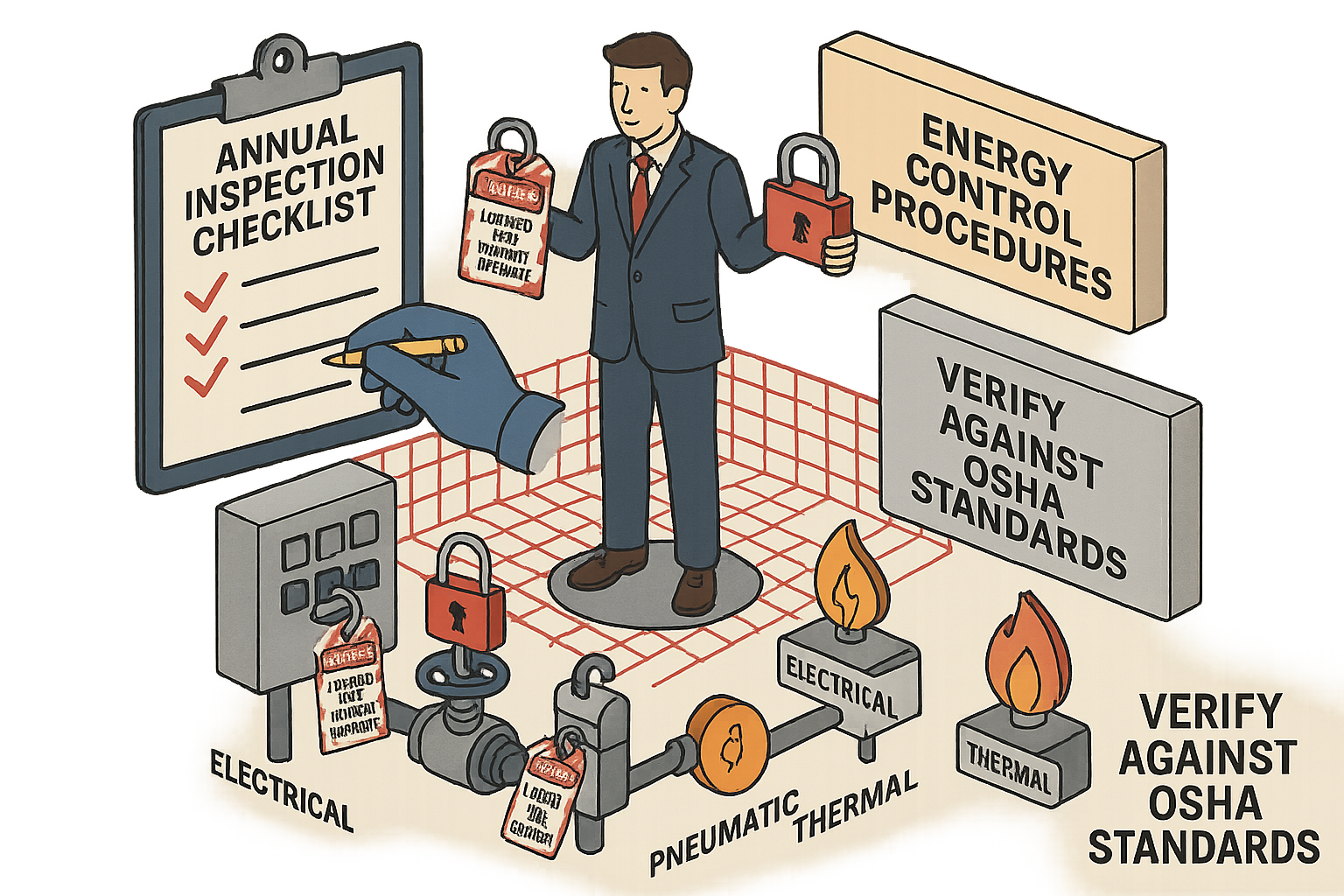
A Lockout Tagout Annual Inspection Checklist is the documented verification that your energy control procedures actually work as written. OSHA requires these periodic inspections annually—not as a suggestion, but as a regulatory mandate under 29 CFR 1910.147(c)(6). Failing to conduct thorough inspections resulted in $16,131 cost per violation in FY2024, with penalties escalating for repeat offenders. A comprehensive checklist ensures every machine, procedure, and authorized employee competency is verified before an inspector does it for you.
Key checklist elements include:
- Equipment identification and isolation point verification
- Procedure accuracy against actual machine configuration
- Employee demonstration of proper lockout sequence
- Certification documentation with dates, names, and findings
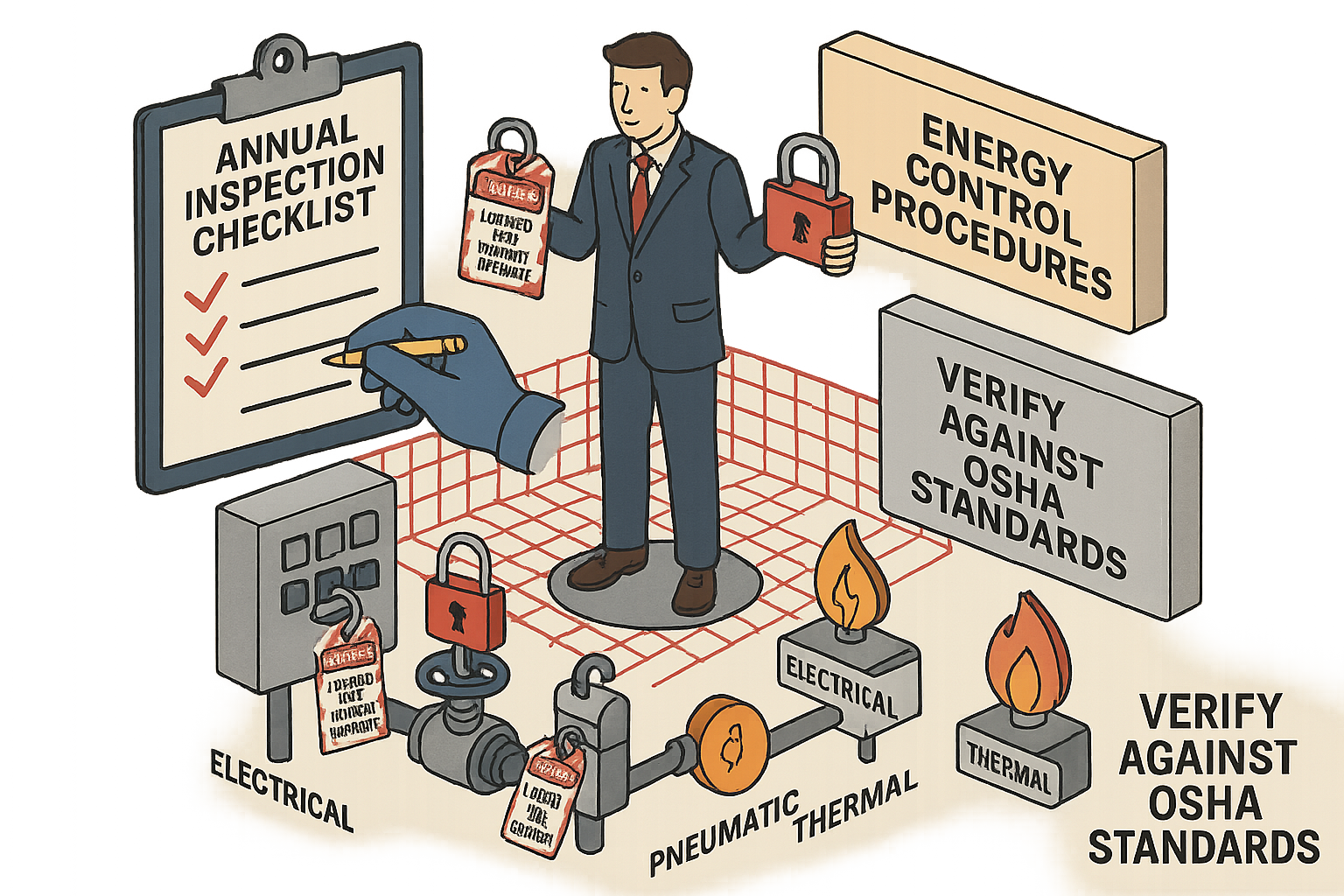
A Lockout Tagout Annual Inspection Checklist is a type of legal document that creates auditable proof your facility meets OSHA requirements for hazardous energy control. This checklist ensures Safety Standards are maintained across every piece of equipment requiring LOTO procedures.
362 companies cited for periodic inspection violations in fy2024. That number represents facilities that thought they were compliant—until an inspector proved otherwise.
Here’s what most safety managers miss: the direct osha fine is just the opening act. The hidden financial cascade starts immediately after citation:
The Compliance Cost Hierarchy:
COMMON TRAP: Facilities treat annual LOTO training as equivalent to annual periodic inspection. They’re not interchangeable. Training teaches employees the procedure. Inspection verifies they actually follow it correctly on specific machines. OSHA cites for this confusion constantly.
The Lockout Tagout Annual Inspection Checklist functions as your compliance defense—documented evidence that you verified every procedure before regulators arrived. Without it, you’re gambling that 362 other companies made mistakes you didn’t.
Compliance Standards are enforced by OSHA through unannounced facility visits. Your checklist is the first document they request.
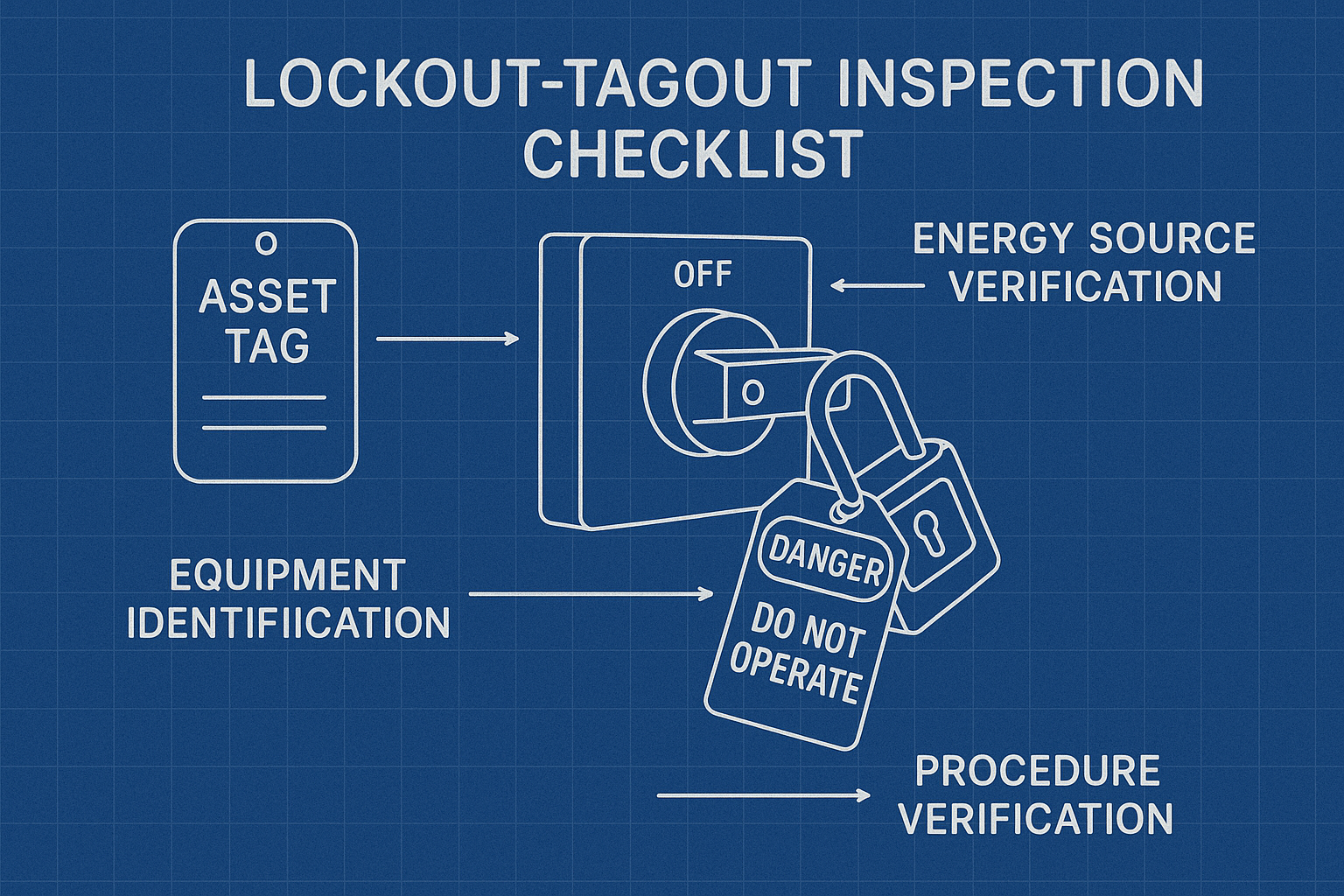
A Lockout Tagout Annual Inspection Checklist includes every Inspection Procedure element required to verify compliance. Each Inspection Procedure verifies your Lockout Tagout Procedure matches reality—not what someone wrote three years ago when the machine was new.
These are the components inspectors look for first, ranked by citation frequency:
Machine/Equipment Identification: Specific asset tag, location, and energy sources. Generic entries like “Press #1” without serial numbers fail audits. Every machine needs unique identification linking to its specific procedure.
Energy Source Verification: Documented confirmation that ALL hazardous energy sources are identified—electrical, hydraulic, pneumatic, thermal, gravitational. Missing one pneumatic accumulator killed a maintenance worker in 2023.
Isolation Point Accuracy: Physical verification that the procedure lists correct breaker numbers, valve locations, and lockout points. Equipment modifications without procedure updates cause 40% of inspection failures.
Authorized Employee Demonstration: The inspector must observe an authorized employee actually perform the lockout sequence on the specific equipment. Reading the procedure aloud doesn’t count.
Try-Start Verification: Documented proof the employee attempted to restart the machine after lockout to confirm zero energy state. Skipping this step is the most dangerous shortcut.
Inspector Qualification Check: The person conducting the inspection must be an authorized employee OTHER than the one being observed. Self-inspection fails OSHA requirements every time.
Certification Elements: Date, machine inspected, employeesincluded, and inspector name. Missing any single element invalidates the entire certification.
IN PRACTICE: The most frequently missed item is energy source verification on modified equipment. That CNC machine got a new hydraulic accumulator last quarter—is it in the procedure? Check before OSHA does.
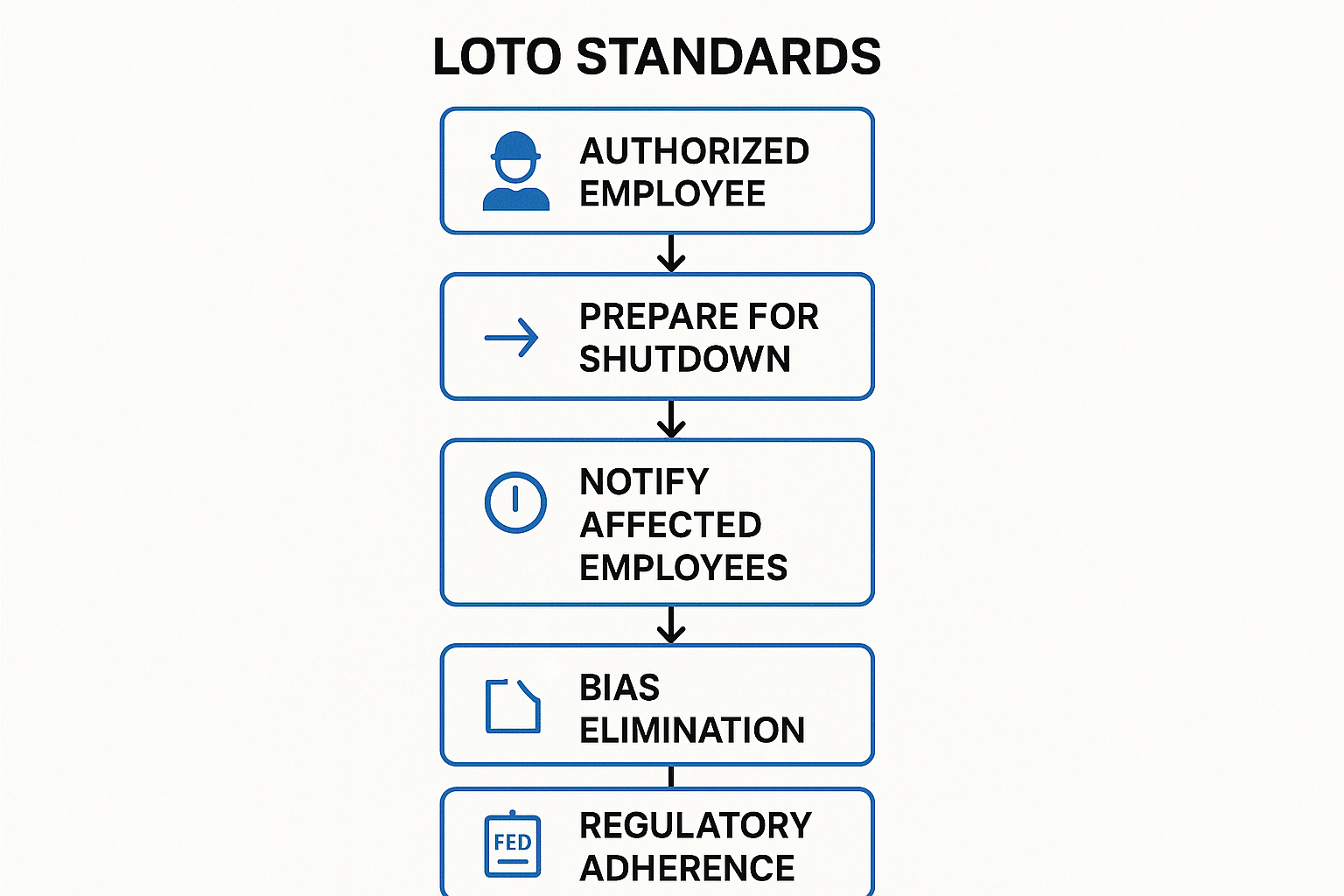
The Lockout Tagout Annual Inspection Checklist must adhere to Specific LOTO standards codified in federal regulation. These Specific LOTO standards define the Safety Standards your inspections must verify.
The controlling regulation is explicit:
“The periodic inspection shall be conducted by an authorized employee other than the one(s) utilizing the energy control procedure being inspected.”
— 29 CFR 1910. 147(c)(6)(i)(B)
What This Actually Means: You cannot inspect your own work. The employee who performs lockout on a specific machine daily cannot be the inspector for that machine’s annual inspection. This isn’t bureaucratic overhead—it’s bias elimination.
The Standards-to-Action Translation Framework:
| Standard Requirement | Practical Inspection Step |
|---|---|
| “At least annually” | Calendar reminder 30 days before anniversary date |
| “Each energy control procedure” | Individual checklist per machine, not batch processing |
| “Authorized employee other than” | Rotation schedule ensuring no self-inspection |
| “Review responsibilities” | Verbal Q&A with employee demonstrating lockout |
| “Certify” | Signed documentation with all four required elements |
The standard evolves through Letters of Interpretation. The 2012 clarification confirmed that inspection of procedures used by contractors still requires an authorized employee from YOUR facility—you cannot delegate compliance to a contractor’s safety program.
COMPLIANCE NOTE: When Specific LOTO standards change through new interpretations, your checklist must update within 90 days. The January 2020 LOI clarified master key requirements—facilities using pre-2020 procedures may have compliance gaps.
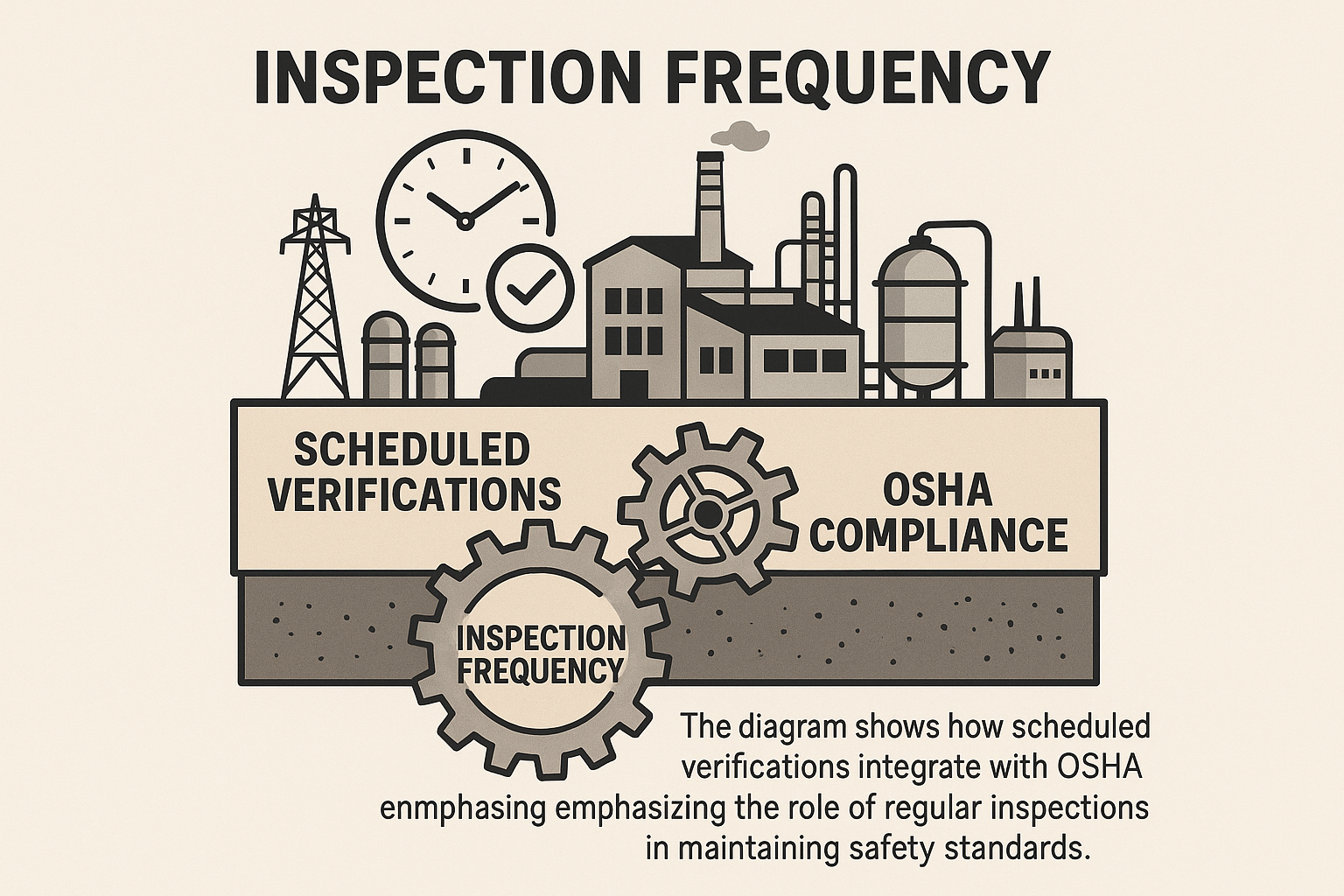
The Lockout Tagout Annual Inspection Checklist is conducted with defined Inspection Frequency requirements. Inspection Frequency impacts Safety Standards compliance and directly affects your liability exposure.
Annual is the regulatory minimum. But here’s the calculation most facilities never run:
10 missed machine-specific inspections could cost $161,310.
That’s not a typo. Each machine without a documented annual inspection constitutes a separate violation. Ten machines × $16,131 = six figures before the inspector finishes the first floor.
The Frequency Optimization Framework:
| Equipment Category | Minimum Frequency | Risk-Based Recommendation |
|---|---|---|
| Standard production equipment | Annual | Annual |
| High-energy systems (>480V, hydraulic presses) | Annual | Semi-annual |
| Frequently modified machines | Annual | After each modification + annual |
| Contractor-accessed equipment | Annual | Before each contract + annual |
The math favors front-loading your inspection schedule:
Spreading inspections across departments by quarter reduces the administrative burden while maintaining continuous compliance posture. January: electrical. April: hydraulic. July: pneumatic. October: multi-energy systems.
COMMON TRAP: “We inspect when equipment breaks” is reactive maintenance, not periodic inspection. OSHA requires scheduled verification regardless of equipment condition. A perfectly functioning machine still needs its annual inspection.
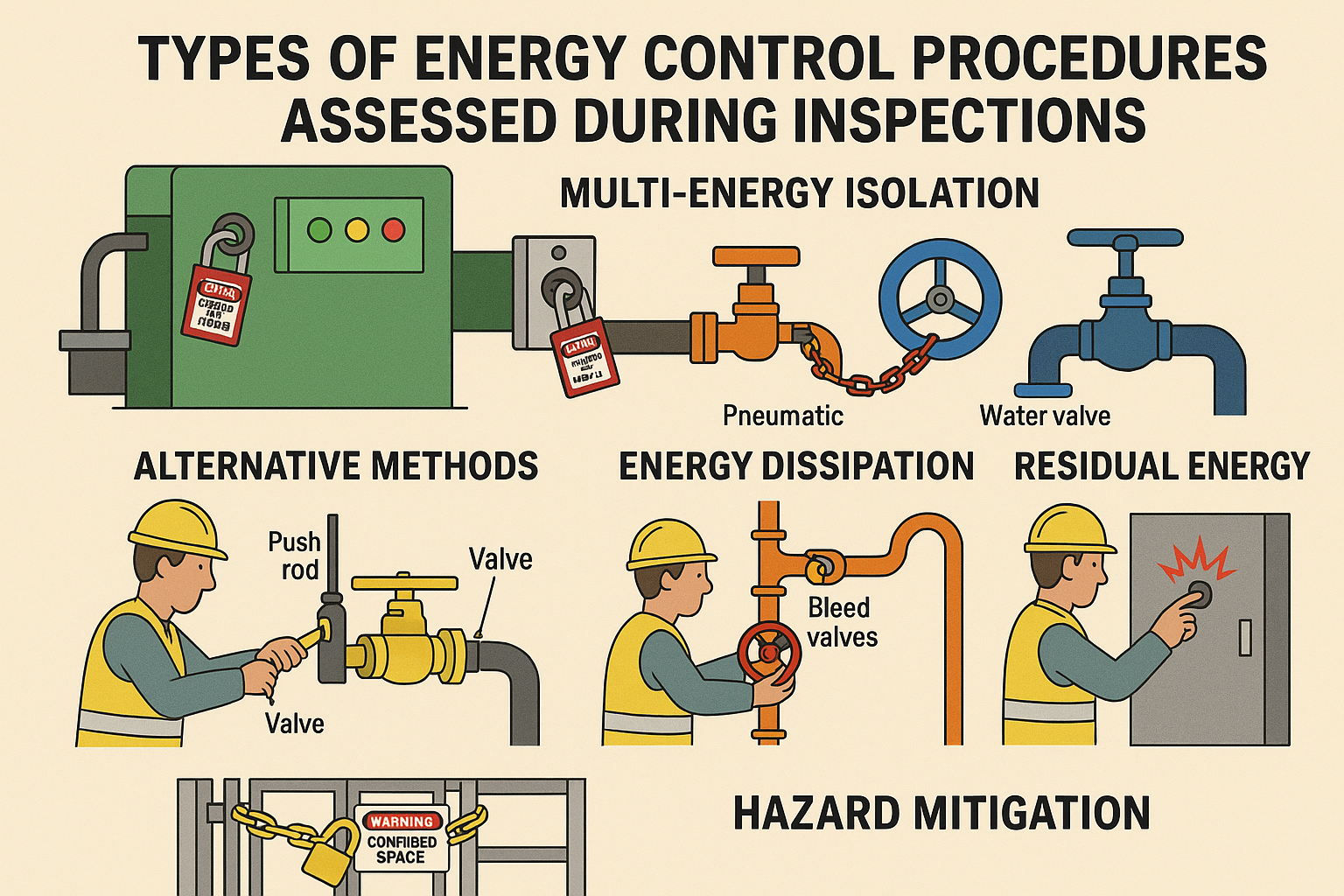
The Lockout Tagout Annual Inspection Checklist evaluates all Types of energy control procedures your facility uses. Each of these Types of energy control procedures mitigates specific Hazardous Energy sources.
Not all procedures carry equal risk. The Risk-Weighted Procedure Assessment Framework:
Tier 1: Critical Priority (Verify First)
Tier 2: High Priority
Tier 3: Standard Priority
Single-energy electrical isolation
Simple valve lockouts
Cord-and-plug equipment (when exclusive control isn’t maintained)
Electrical Isolation Procedures: Verify breaker identification, verify lockout device placement point, verify zero-energy testing method. The inspector confirms the procedure matches the actual panel configuration.
Hydraulic/Pneumatic Procedures: Verify all accumulator bleed-down steps are documented. Stored energy in hydraulic systems killed more workers than electrical contact in 2023.
Mechanical Procedures: Verify blocking requirements for gravity-loaded components. Elevated dies, suspended loads, and spring-tensioned mechanisms need specific securing steps.
Multi-Energy Procedures: Verify isolation sequence addresses ALL energy types. The most cited procedures list electrical lockout but ignore the pneumatic cylinder that can still cycle.
IN PRACTICE: When inspecting a multi-energy procedure, physically walk the isolation sequence with the authorized employee. Desk reviews miss the valve that got relocated during last year’s equipment reconfiguration.
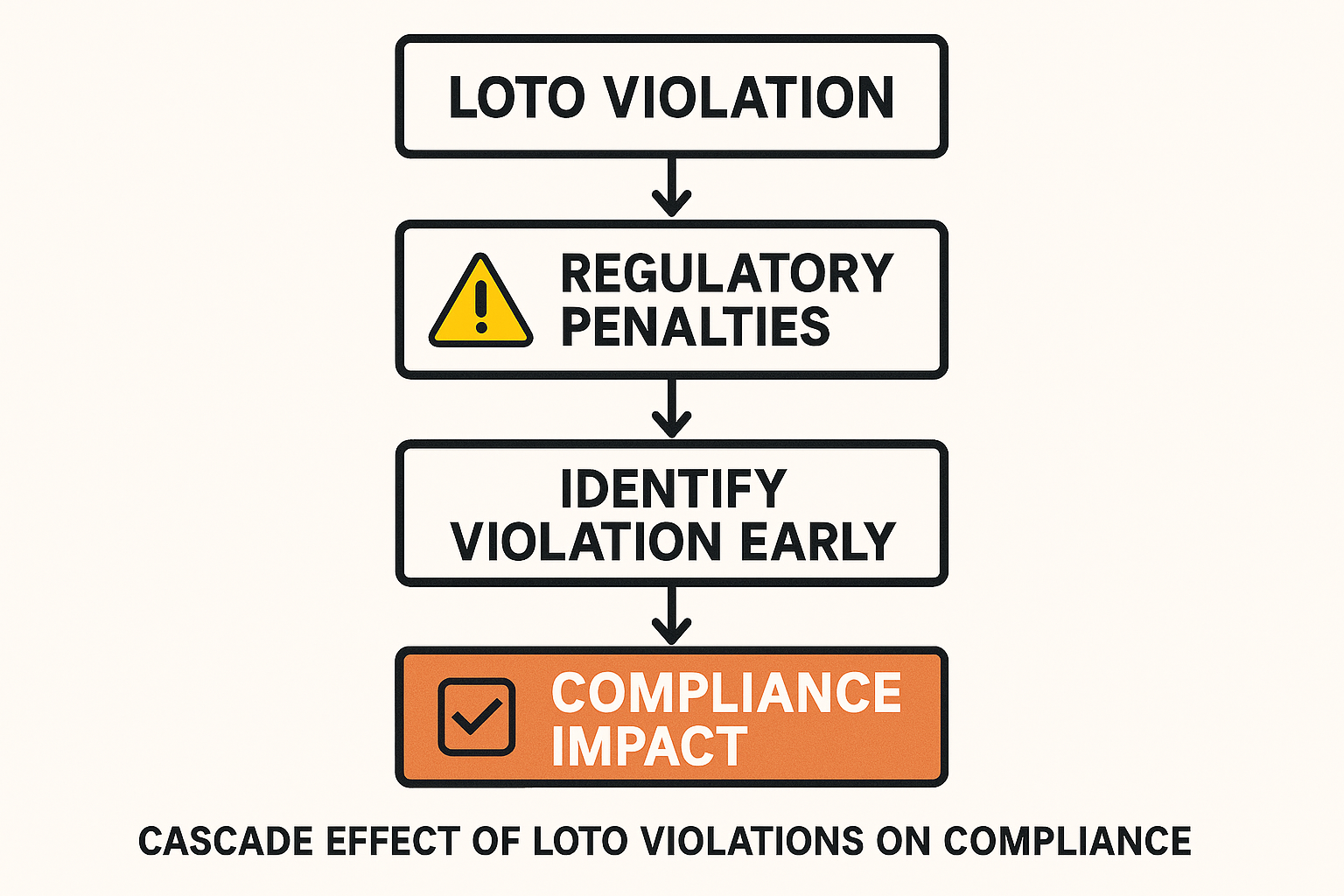
The Lockout Tagout Annual Inspection Checklist identifies potential Consequences of LOTO violations before regulators do. These Consequences of LOTO violations impact Safety Regulations compliance and cascade through your entire operation.
$16,131 cost per violation—that’s the headline number. Here’s what happens after:
Immediate Consequences (Days 1-30):
Short-Term Consequences (Months 1-6):
Long-Term Consequences (Years 1-3):
The Real Cost Calculation:
| Violation Scenario | Direct Fine | Indirect Costs | 3-Year Total |
|---|---|---|---|
| Single serious violation | $16,131 | $25,000-40,000 | $41,131-56,131 |
| 10-machine inspection gap | $161,310 | $200,000-350,000 | $361,310-511,310 |
| Repeat violation (within 5 years) | $165,514 | $400,000+ | $565,514+ |
The Internal Discovery Advantage:
When your inspection finds the violation first:
COMMON TRAP: Discovering a violation during your own inspection feels like failure. It’s actually success—you found it before the penalty clock started.
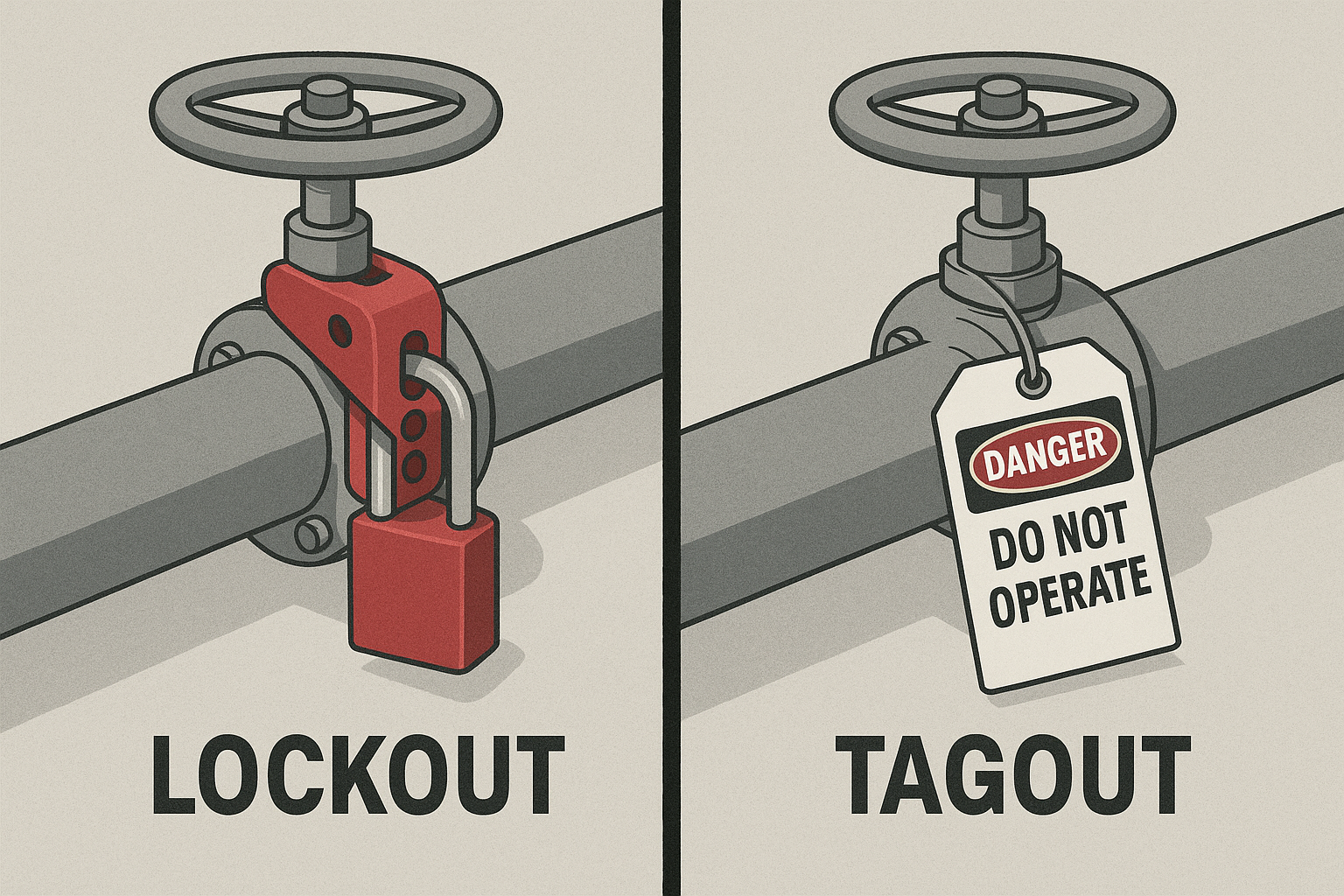
The Lockout Tagout Annual Inspection Checklist assesses both Lockout and Tagout applications across your facility. The inspection evaluates whether each method is appropriately applied to specific equipment configurations.
Lockout physically prevents energy transmission. Tagout warns against re-energization. They’re not interchangeable—OSHA has specific rules for when each applies.
The Decision Framework:
| Equipment Condition | Required Method | Inspection Focus |
|---|---|---|
| Energy isolating device accepts lock | Lockout mandatory | Lock placement, device integrity |
| Device cannot accept lock (legacy equipment) | Tagout with additional measures | Tag attachment (50 lb. minimum), supplemental protection |
| Full tagout capability with documented equivalency | Tagout permitted | Enhanced procedure requirements, additional training verification |
When Tagout is used instead of Lockout, your inspection must verify:
Lockout scenarios requiring inspection emphasis:
Tagout scenarios requiring additional scrutiny:
IN PRACTICE: When inspecting equipment using tagout, ask the employee directly: “What stops someone from removing this tag and energizing the machine?” If the answer is “the tag,” your training has gaps.
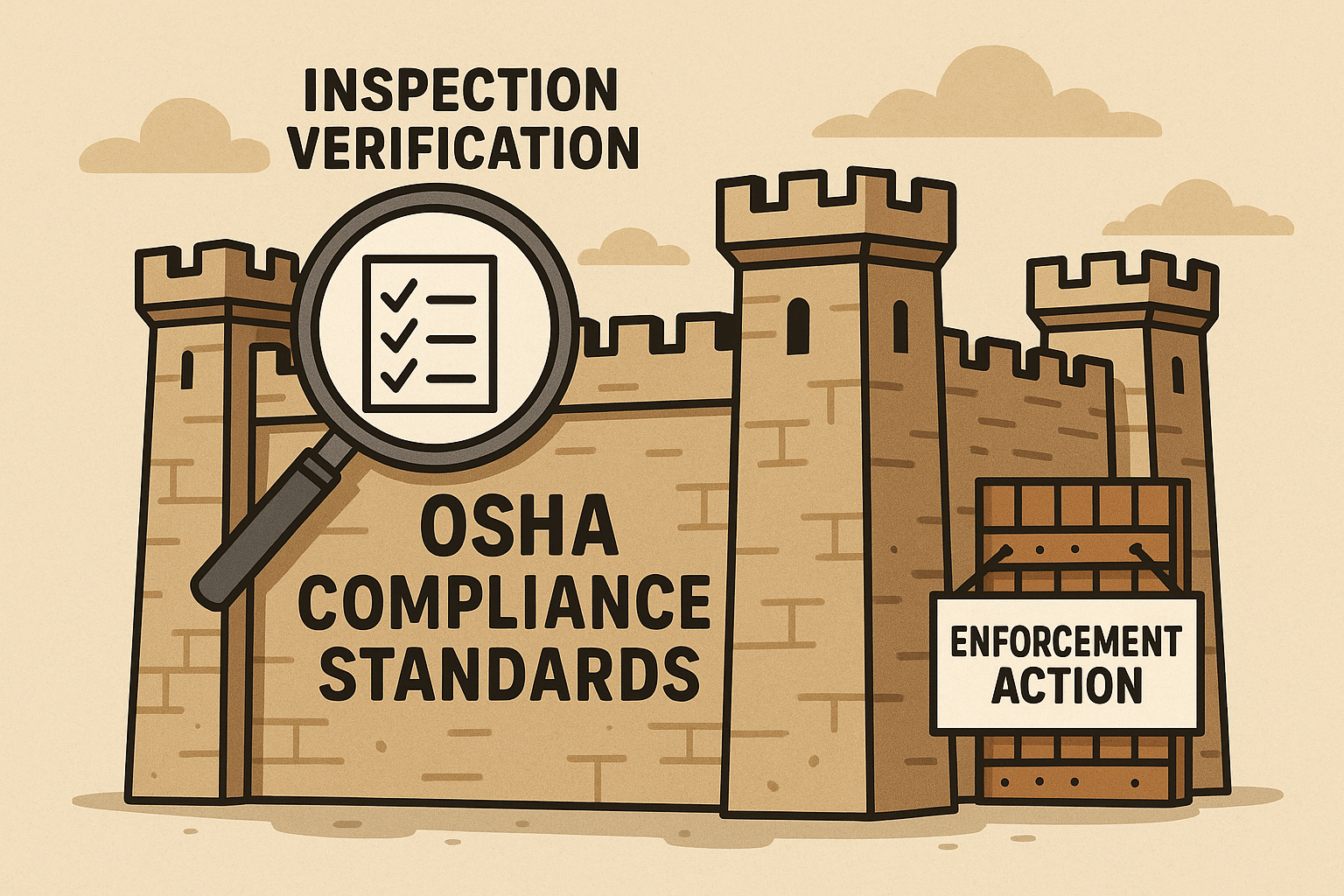
The Lockout Tagout Annual Inspection Checklist ensures Compliance Standards are verified before enforcement action. Compliance Standards are enforced by OSHA through unannounced facility inspections, whistleblower investigations, and fatality/injury investigations.
362 companies cited by OSHA in FY2024 for periodic inspection failures alone. Each one had a safety program. Each one thought they were compliant.
The Pre-Audit Verification Protocol:
Here’s how to use your checklist to identify violations before OSHA arrives:
Step 1: Documentation Audit
Step 2: Procedure-to-Reality Check
Step 3: Inspector Qualification Review
Step 4: Training Record Alignment
COMPLIANCE NOTE: OSHA inspectors request these documents in a specific sequence: written program → machine-specific procedures → inspection certifications → training records. Missing links in this chain trigger deeper investigation.
The Compliance Cascade Prevention Model:
| If Missing… | Triggers Investigation Of… | Potential Additional Citations |
|---|---|---|
| Written program | Everything downstream | (c)(1), (c)(4), (c)(6), (c)(7) |
| Machine-specific procedures | Inspections, training | (c)(4), (c)(6), (c)(7) |
| Inspection certifications | Training records, incident history | (c)(6), (c)(7) |
| Training records | None (terminal failure) | (c)(7) |
Your checklist isn’t paperwork. It’s the documented proof that you verified compliance before OSHA verified your failures.
A Lockout Tagout Annual Inspection Checklist is a legal compliance document verifying energy control procedures work correctly. Required by OSHA under 29 CFR 1910.147(c)(6), these inspections prevent the $16,131 per-violation fines that hit 362 companies in FY2024. The checklist ensures every machine procedure matches actual equipment configuration.
Key components include machine identification, energy source verification, isolation point accuracy, authorized employee demonstration, try-start confirmation, inspector qualification, and complete certification documentation. Each Inspection Procedure verifies the written Lockout Tagout Procedure matches physical equipment reality. Missing any element can invalidate the entire inspection.
Specific LOTO standards under 29 CFR 1910. 147(c)(6)(i)(B) require inspections by an authorized employee OTHER than the one using the procedure. These standards define what must be verified—procedure accuracy, employee competency, and equipment configuration. Standards evolve through OSHA Letters of Interpretation, requiring checklist updates.
Inspection Frequency must be annual minimum per OSHA requirements, but risk-based scheduling improves outcomes. 10 missed machine-specific inspections could cost $161,310 in penalties alone. Quarterly scheduling by equipment category spreads administrative burden while maintaining continuous compliance and identifying issues before busy production periods.
Inspections evaluate electrical isolation, hydraulic/pneumatic procedures, mechanical blocking requirements, and multi-energy sequences. Each procedure type addresses specific Hazardous Energy sources. Multi-energy machines receive priority focus because incomplete isolation sequences represent the highest-risk compliance gap in most facilities.
LOTO violations carry $16,131 cost per violation for serious citations, escalating to $165,514 for repeat offenses. Beyond direct fines, consequences include insurance premium increases, workers’ compensation audits, public citation posting, and “history of violations” classification affecting all future OSHA interactions.
Inspections assess whether Lockout or Tagout is appropriately applied to each equipment type. Lockout physically prevents energy transmission; Tagout provides warning. When Tagout substitutes for Lockout, inspections verify 50-pound attachment strength, enhanced procedures, and additional employee training on tagout limitations.
The checklist creates documented proof that Compliance Standards were verified before OSHA inspection. 362 companies cited by OSHA in FY2024 lacked this documentation. The checklist systematically addresses program requirements, procedure accuracy, inspection certification, and training records—the exact sequence inspectors investigate.