Physical Address
304 North Cardinal St.
Dorchester Center, MA 02124
Physical Address
304 North Cardinal St.
Dorchester Center, MA 02124


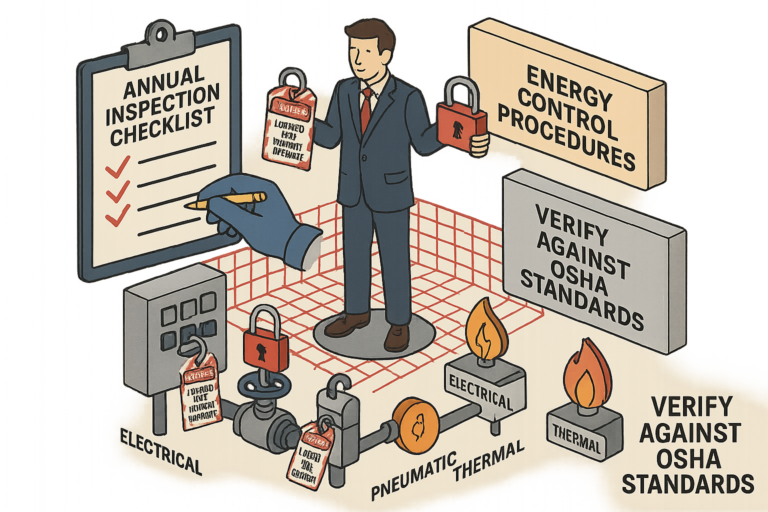
You inherited a lockout tagout program. Maybe it’s a binder collecting dust in the safety office. Maybe it’s a SharePoint folder nobody’s opened since 2019. Either way, you know what’s coming: an osha inspector who’s going to ask questions your documentation can’t answer.
OSHA lockout tagout requirements aren’t complicated. They’re just specific — and specificity is where most programs fail.
In FY2024, OSHA issued 2,443 LOTO citations. That made 29 cfr 1910.147 the #5 most-cited standard. The pattern hasn’t changed in twenty years: companies have programs, but the programs don’t match what OSHA actually requires.
This guide breaks down each requirement in 1910.147, translates the regulatory language into what actually matters during an audit, and shows you where programs typically fall apart. If you’re an EHS manager trying to figure out whether your inherited program will survive inspection, start here.
Before diving into specific lockout tagout requirements, you need to understand what the standard covers — and what it doesn’t.
29 CFR 1910.147 is a servicing and maintenance standard. It applies when employees perform activities where unexpected energization, startup, or release of stored energy could cause injury. That covers everything from changing a blade on a punch press to clearing a jam in a conveyor system.
“This standard covers the servicing and maintenance of machines and equipment in which the unexpected energization or start up of the machines or equipment, or release of stored energy, could harm employees.”
— 29 CFR 1910.147(a)(1)(i)
Shop Floor Translation: If someone could get hurt because a machine unexpectedly starts, moves, or releases energy while they’re working on it, LOTO applies. Period.
The standard has specific exclusions that confuse people:
Cord-and-plug equipment — If the equipment is unplugged and the plug remains under the exclusive control of the employee performing the work, LOTO requirements don’t apply. But “exclusive control” has a specific meaning: the plug must be within arm’s reach and line of sight, or you must use a plug lockout device.
Construction and agriculture — Different OSHA standards apply.
Oil and gas well drilling — Covered under different regulations.
Electrical utility generation, transmission, and distribution — Covered under 1910.269.
AUDIT TRAP: “Exclusive control” doesn’t mean the plug is somewhere in the same room. If the plug is 15 feet away while you’re servicing the machine, another employee could plug it back in. That’s not exclusive control. Either stay within arm’s reach OR lock out the plug itself with a plug lockout device.
LOTO doesn’t exist in isolation. For electrical work, you also need to consider:
The standards overlap but don’t conflict. 1910.147 covers the control of hazardous energy broadly. 1910.333 adds specific electrical safety requirements. When both apply, you follow both.
The foundation of OSHA lockout tagout requirements is the written energy control program. This is covered under 1910.147(c)(1).
“The employer shall establish a program consisting of energy control procedures, employee training and periodic inspections to ensure that before any employee performs any servicing or maintenance on a machine or equipment where the unexpected energizing, startup or release of stored energy could occur and cause injury, the machine or equipment shall be isolated from the energy source and rendered inoperative.”
— 29 CFR 1910.147(c)(1)(i)
Shop Floor Translation: You need three things in writing: procedures for controlling energy, a training program, and an inspection process. All three. In writing. Before anyone touches equipment.
An energy control program is a comprehensive written program with:
| Component | Purpose | Common Failure |
|---|---|---|
| Energy Control Procedures | Machine-specific lockout steps | Generic procedures that don’t specify the machine |
| Employee Training | Ensures workers know how to apply LOTO | Training records exist but content isn’t documented |
| Periodic Inspections | Verifies procedures are followed | Confusing annual training with annual inspection |
Here’s where programs fall apart: companies create a policy document and call it a program.
A policy statement says “We will lock out equipment before servicing.” That’s not a program — that’s an intention.
A program includes the specific procedures for each piece of equipment, the training curriculum, the inspection protocol, and the documentation proving all three exist and function.
OSHA cited 289 companies last year under (c)(1) — Energy Control Program violations. In most cases, the company had something written. It just wasn’t a complete program.
Your written energy control program must document:
This program document is the umbrella. Under it sit your machine-specific procedures, training records, and inspection certifications.
Energy control procedure violations are the #1 LOTO citation. OSHA issued 730 citations under (c)(4) last year. This single subsection accounts for nearly a third of all LOTO violations.
The reason is simple: companies write generic procedures and call them machine-specific.
“Procedures shall be developed, documented and utilized for the control of potentially hazardous energy when employees are engaged in the activities covered by this section.”
— 29 CFR 1910.147(c)(4)(i)
Shop Floor Translation: Every piece of equipment that requires LOTO needs its own written procedure. Not a generic procedure with a blank line for the machine name. A procedure written specifically for that machine, with that machine’s energy sources, isolation points, and verification steps.
Per 1910.147(c)(4)(ii), each machine-specific procedure must contain:
The word “specific” appears four times. OSHA isn’t being redundant — they’re emphasizing that generic doesn’t cut it.
A compliant machine-specific procedure identifies:
| Element | Example — Generic (Fails) | Example — Machine-Specific (Passes) |
|---|---|---|
| Equipment | “Hydraulic Press” | “Dake 50-Ton H-Frame Press, Asset #HP-2340, Building 3” |
| Energy Sources | “Electrical and hydraulic” | “480V 3-phase electrical (60A disconnect on east wall), hydraulic pressure (3,000 PSI max, accumulator behind press)” |
| Isolation Points | “Main disconnect and valve” | “Disconnect switch DS-12 (red handle, east wall), ball valve BV-42 (yellow handle, hydraulic manifold)” |
| Verification | “Test before work” | “Press RUN button at operator panel to verify zero energy state; verify hydraulic gauge reads 0 PSI” |
OSHA allows an exception to written procedures when ALL eight conditions are met:
AUDIT TRAP: Condition #8 is the killer. If you’ve EVER had an incident involving unexpected energization on that machine — even a near-miss you documented — the exception no longer applies. One incident = mandatory written procedure forever.
In practice, the eight-criteria exception rarely applies to industrial equipment. Most machines have multiple energy sources, stored energy, or a history of incidents. Write the procedures.

OSHA lockout tagout requirements include specific standards for the devices themselves. This is covered under 1910.147(c)(5).
“Locks, tags, chains, wedges, key blocks, adapter pins, self-locking fasteners, or other hardware shall be provided by the employer for isolating, securing or blocking of machines or equipment from energy sources.”
— 29 CFR 1910.147(c)(5)(i)
Shop Floor Translation: The employer provides the lockout devices. Employees don’t bring their own padlocks from home. And those devices must meet four specific requirements.
Every lockout device and tagout device must be:
| Requirement | Regulatory Cite | What It Means | Failure Example |
|---|---|---|---|
| Durable | (c)(5)(ii)(A) | Withstands environment for maximum expected exposure | Paper tags that dissolve; chrome locks rusting outdoors |
| Standardized | (c)(5)(ii)(B) | Consistent color, shape, or size facility-wide | Random personal padlocks; mixed red and blue locks |
| Substantial | (c)(5)(ii)(C) | Cannot be removed without excessive force | Cheap locks that can be twisted off by hand |
| Identifiable | (c)(5)(ii)(D) | Indicates identity of applying employee | Anonymous locks without ID tags; shared locks |
For lockout devices, “substantial” means:
“Lockout devices… shall be substantial enough to prevent removal without the use of excessive force or unusual techniques, such as with the use of bolt cutters or other metal cutting tools.”
— 29 CFR 1910.147(c)(5)(ii)(C)(1)
Shop Floor Translation: If a determined person can defeat the lock without bolt cutters, it’s not substantial. That $5 padlock from the hardware store with the 3mm shackle? Not compliant. An industrial safety padlock with a 6mm hardened steel shackle? Compliant.
For tagout devices, the “substantial” requirement is even more specific:
“Tagout device attachment means shall be of a non-reusable type, attachable by hand, self-locking, and non-releasable with a minimum unlocking strength of no less than 50 pounds…”
— 29 CFR 1910.147(c)(5)(ii)(C)(2)
The 50-Pound Rule: Those plastic zip-ties from the office supply closet? They’re rated for 18-35 pounds. They fail this requirement. You need industrial 1/4″ nylon cable ties rated for 75+ pounds.
| COMPLIANT Tag Attachments | NON-COMPLIANT Tag Attachments |
|---|---|
| Industrial 1/4″ nylon cable ties (75+ lb.) | Standard office zip-ties (18-35 lb.) |
| Self-locking nylon straps with tensile rating | String, wire, or cord |
| Single-use plastic loop attachments | Reusable cable ties |
| Metal-reinforced nylon ties | Adhesive attachments |
Lockout is the default. Tagout is the exception.
“Whenever replacement or major repair, renovation or modification of a machine or equipment is performed, and whenever new machines or equipment are installed, energy isolating devices for such machine or equipment shall be designed to accept a lockout device.”
— 29 CFR 1910.147(c)(2)(iii)
Shop Floor Translation: Any equipment installed or significantly modified after January 2, 1990 must accept a lockout device. If it doesn’t, you have a problem.
Tagout alone is only acceptable when:
In practice, almost all equipment can be locked out. If your energy isolating device doesn’t accept a lock, add an adapter. Valve lockouts, circuit breaker lockouts, and universal lockout devices exist for exactly this reason.
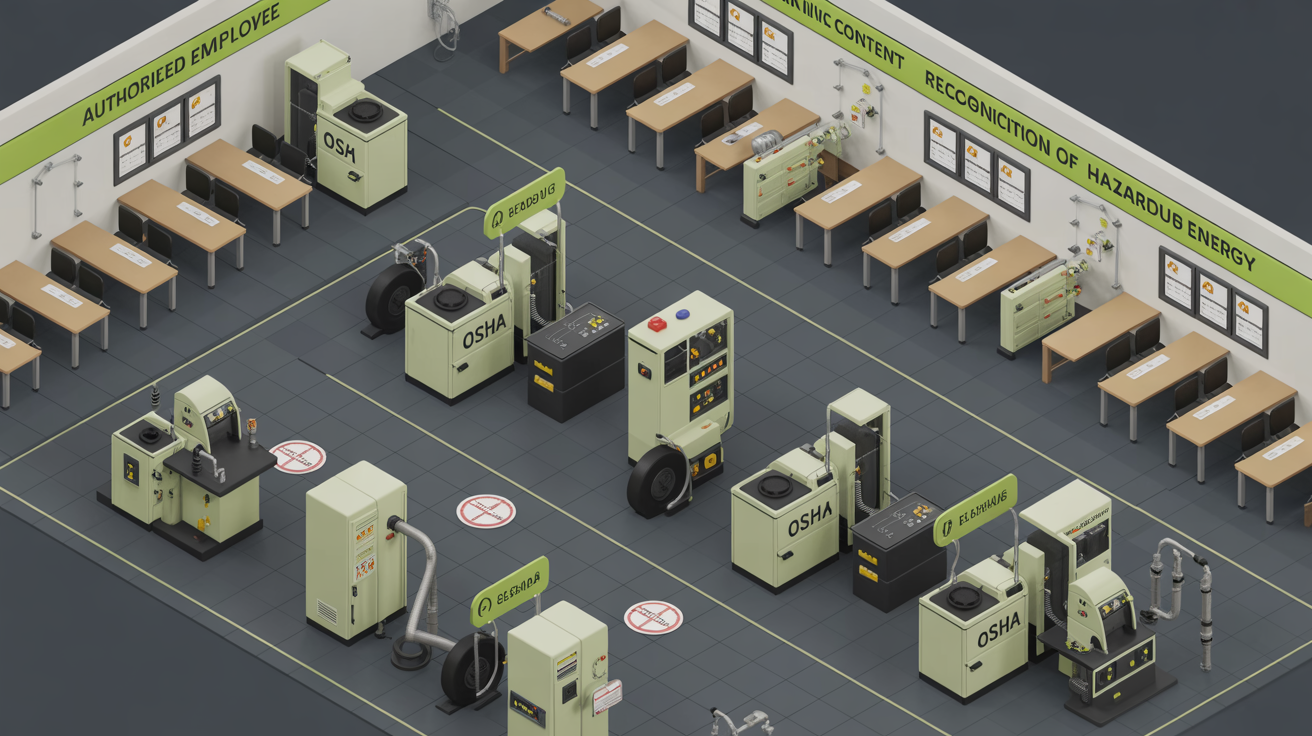
Training requirements under 1910.147(c)(7) account for 491 citations annually — the #2 most-cited LOTO subsection. The problem isn’t that companies skip training. The problem is they train everyone the same way.
OSHA defines three categories of employees. Each requires different training.
| Employee Type | Definition | Required Training Content |
|---|---|---|
| Authorized Employee | Person who locks out/tags out machines to perform servicing | Recognition of hazardous energy sources; type and magnitude of energy; methods and means for isolation and control |
| Affected Employee | Person whose job requires operating or using a machine, or working in an area where servicing is performed | Purpose and use of the energy control procedure |
| Other Employee | All other employees in areas where energy control may be used | Recognition that the procedure is being used; understanding that attempting to restart locked-out equipment is prohibited |
“The employer shall provide training to ensure that the purpose and function of the energy control program are understood by employees and that the knowledge and skills required for the safe application, usage, and removal of the energy controls are acquired by employees.”
— 29 CFR 1910.147(c)(7)(i)
Shop Floor Translation: Authorized employees need to know HOW to lock out specific equipment. Affected employees need to know WHY lockout happens and how to recognize it. Everyone else needs to know DON’T TOUCH equipment that’s locked out.
An authorized employee is a person who locks out or tags out machines or equipment to perform servicing or maintenance. Their training must include:
This isn’t a generic safety video. Authorized employee training must be equipment-specific. An authorized employee on the CNC lathe needs different training than an authorized employee on the hydraulic press.
When tagout is used (instead of or in addition to lockout), employees must receive additional training on tagout limitations:
“Tag limitations… Tags are essentially warning devices affixed to energy isolating devices and do not provide the physical restraint on those devices that is provided by a lock.”
— 29 CFR 1910.147(c)(7)(ii)
Employees must understand that:
AUDIT TRAP: Failure to document “tagout limitations” training is a frequent citation. Even if you primarily use lockout, ANY use of tagout anywhere in your facility requires this additional training element for all affected employees.
“The employer shall certify that employee training has been accomplished and is being kept up to date. The certification shall contain each employee’s name and dates of training.”
— 29 CFR 1910.147(c)(7)(iv)
At minimum, training records must include:
Smart employers also document:
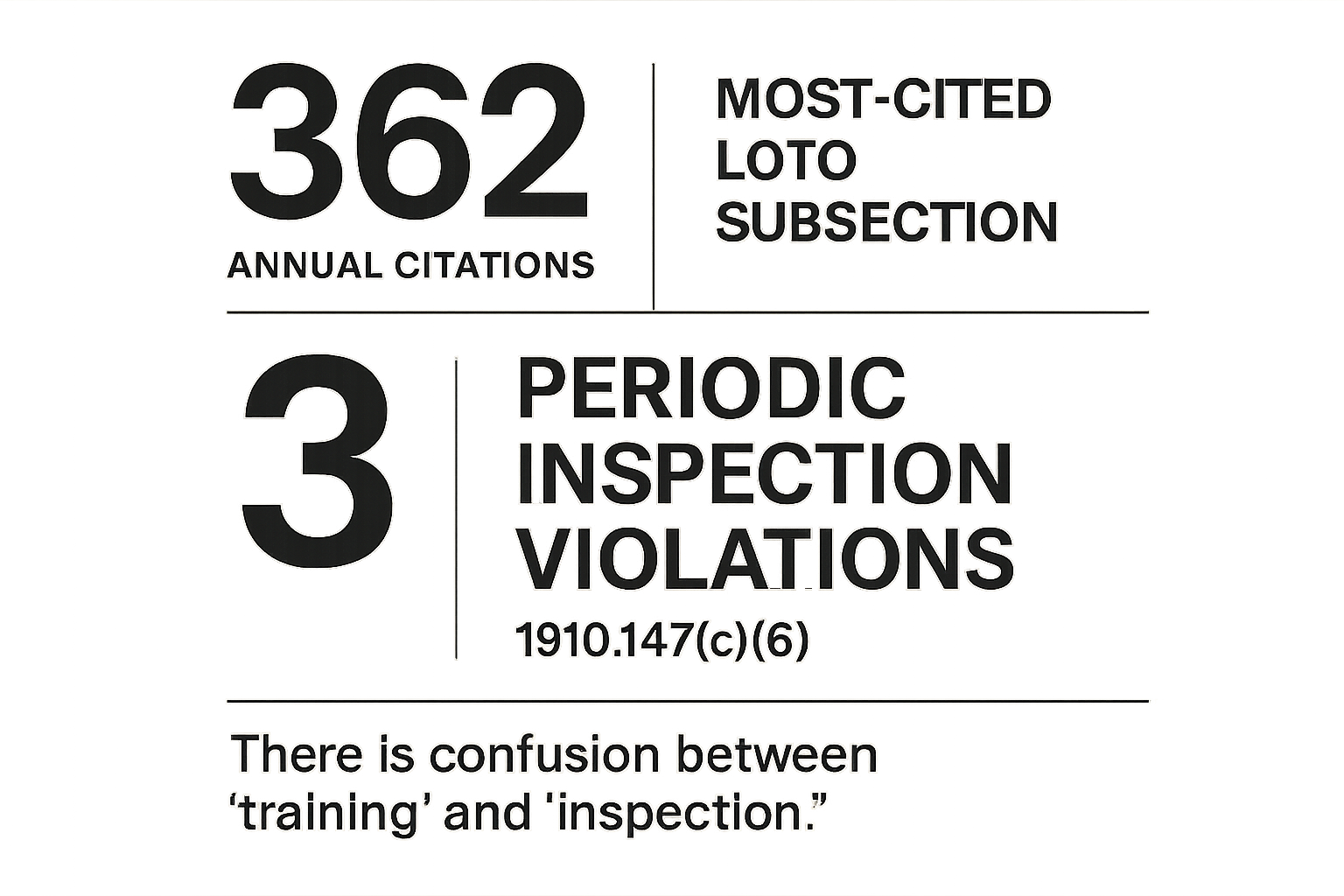
Periodic inspection violations under 1910.147(c)(6) account for 362 citations annually — the #3 most-cited LOTO subsection. The citation count keeps growing because employers confuse training with inspection.
They’re not the same thing.
“The employer shall conduct a periodic inspection of the energy control procedure at least annually to ensure that the procedure and the requirements of this standard are being followed.”
— 29 CFR 1910.147(c)(6)(i)
Shop Floor Translation: Once a year, for EACH machine-specific procedure, someone must WATCH employees actually perform the lockout. Then document it. Annual training doesn’t satisfy this requirement.
A compliant periodic inspection includes:
“The periodic inspection shall be performed by an authorized employee other than the ones(s) utilizing the energy control procedure being inspected.”
— 29 CFR 1910.147(c)(6)(i)(A)
Shop Floor Translation: The person who normally locks out a machine cannot inspect their own procedure. You need a different authorized employee — someone qualified in LOTO but not the regular operator of that equipment.
| COMPLIANT Inspector | NON-COMPLIANT Inspector |
|---|---|
| Authorized employee from different department | The same employee who uses the procedure daily |
| Safety manager who is also an authorized employee | Affected employee who doesn’t perform LOTO |
| Maintenance supervisor inspecting operator procedures | Outside consultant who isn’t an authorized employee |
“The employer shall certify that the periodic inspections have been performed. The certification shall identify the machine or equipment on which the energy control procedure was being utilized, the date of the inspection, the employees included in the inspection, and the person performing the inspection.”
— 29 CFR 1910.147(c)(6)(ii)
Certification documentation MUST include:
AUDIT TRAP: “We do annual LOTO training” is NOT the same as “annual periodic inspection.” Training teaches employees what to do. Inspection VERIFIES they’re doing it. You need both. Separately. Documented separately.
The standard says “at least annually.” That means:
If you have 50 machines with machine-specific procedures, you need 50 annual inspections. Not one big inspection day — 50 individual inspections, each documented separately.

After reviewing OSHA lockout tagout requirements, the patterns become clear. Most citations come from the same gaps.
The biggest gap. Companies create a template with blanks for machine name and energy source, fill it in, and call it machine-specific.
That’s not what OSHA means.
Machine-specific procedures require specific isolation points, specific steps for that exact machine, specific verification methods. A template with blanks filled in doesn’t capture the complexity of a multi-energy source machine.
Fix: Walk down each machine. Identify every energy source and isolation point. Write the procedure standing at the machine, not sitting at a desk.
Companies have sign-in sheets proving employees attended training. They don’t have documentation of what was trained.
When an inspector asks “What did authorized employees learn about hydraulic stored energy?” you need an answer. A signature proves attendance. It doesn’t prove content.
Fix: Keep curriculum documentation. Reference specific training content in sign-off sheets. Test for comprehension.
Supervisors watch employees lock out equipment regularly. They just don’t write it down as a periodic inspection with all four required elements.
Observation without certification doesn’t count.
Fix: Create a periodic inspection form with fields for all four required elements. Schedule inspections on the calendar. Treat them as formal audits.
Locks float around the maintenance shop. Nobody tracks which lock belongs to which employee. Locks have no ID tags.
This violates the “identifiable” requirement. Every lock must indicate who applied it.
Fix: Assign locks to individuals. Engrave names or use photo ID tags. Track lock assignments in a log.
Companies use tags because “that’s how we’ve always done it” — not because the energy isolating device can’t accept a lock.
If a device CAN accept a lock (even with an adapter), you must use lockout.
Fix: Survey all energy isolating devices. Install lockout adapters where needed. Document any devices that genuinely cannot accept a lock, along with additional safety measures.
Answer these honestly:
If you answered “no” to any question, you have a compliance gap.
OSHA lockout tagout requirements under 29 CFR 1910.147 come down to five core elements:
| Requirement | Regulatory Cite | What OSHA Wants to See |
|---|---|---|
| Written Energy Control Program | (c)(1) | Comprehensive program document covering procedures, training, and inspections |
| Machine-Specific Procedures | (c)(4) | Individual procedures for each machine with specific steps and verification |
| Compliant Devices | (c)(5) | Durable, standardized, substantial, identifiable lockout and tagout devices |
| Employee Training | (c)(7) | Documented training appropriate to employee category (authorized/affected/other) |
| Periodic Inspections | (c)(6) | Annual inspection of each procedure with written certification |
The 2,443 LOTO citations issued last year didn’t come from companies ignoring safety. They came from companies with programs that didn’t quite match what the regulation requires. The gap between “we have a LOTO program” and “we comply with 1910.147” is where citations live.
Per 29 CFR 1910.147(c)(6), periodic inspections must occur at least annually for each energy control procedure. This is separate from training — inspection requires observation of employees actually implementing the procedure, plus documented review of responsibilities.
No. Per 1910.147(c)(5)(ii)(D), lockout devices must indicate the identity of the employee applying the device. Shared locks violate this requirement. Each authorized employee must have their own individually assigned lock that identifies them.
A lockout device is a lock that prevents an energy isolating device from being operated. A tagout device is a warning tag attached to an energy isolating device. Lockout physically prevents energization; tagout warns against it. Lockout is required unless the energy isolating device cannot accept a lock AND additional safety measures are implemented.
Written procedures are required for every machine where unexpected energization could cause injury during servicing — unless ALL eight criteria of the exception in 1910.147(c)(4)(i) are met. In practice, most industrial equipment requires written procedures because the eight-criteria exception rarely applies.
Per 1910.147(c)(6)(i)(A), inspections must be performed by an authorized employee OTHER than the one(s) utilizing the energy control procedure being inspected. The inspector must be authorized (trained in LOTO) but cannot be the regular user of that specific procedure.