Physical Address
304 North Cardinal St.
Dorchester Center, MA 02124
Physical Address
304 North Cardinal St.
Dorchester Center, MA 02124


Circuit breaker lockout types cause more fitment failures than any other LOTO hardware category. I’ve watched maintenance techs stand in front of a 480V panel with a $12 “universal” toggle lockout that won’t seat on anything. The toggle rocks back and forth. The shackle hole doesn’t align. And now you’ve got an authorized employee improvising—which is how people get killed.
OSHA doesn’t care that the package said “universal.” They care whether your lockout device actually prevents breaker operation. For more information, see Valve Lockout Device Selection. For more information, see Lockout Tagout Padlocks. For more information, see Valve Lockout Device Selection. For more information, see Lockout Tagout Padlocks.
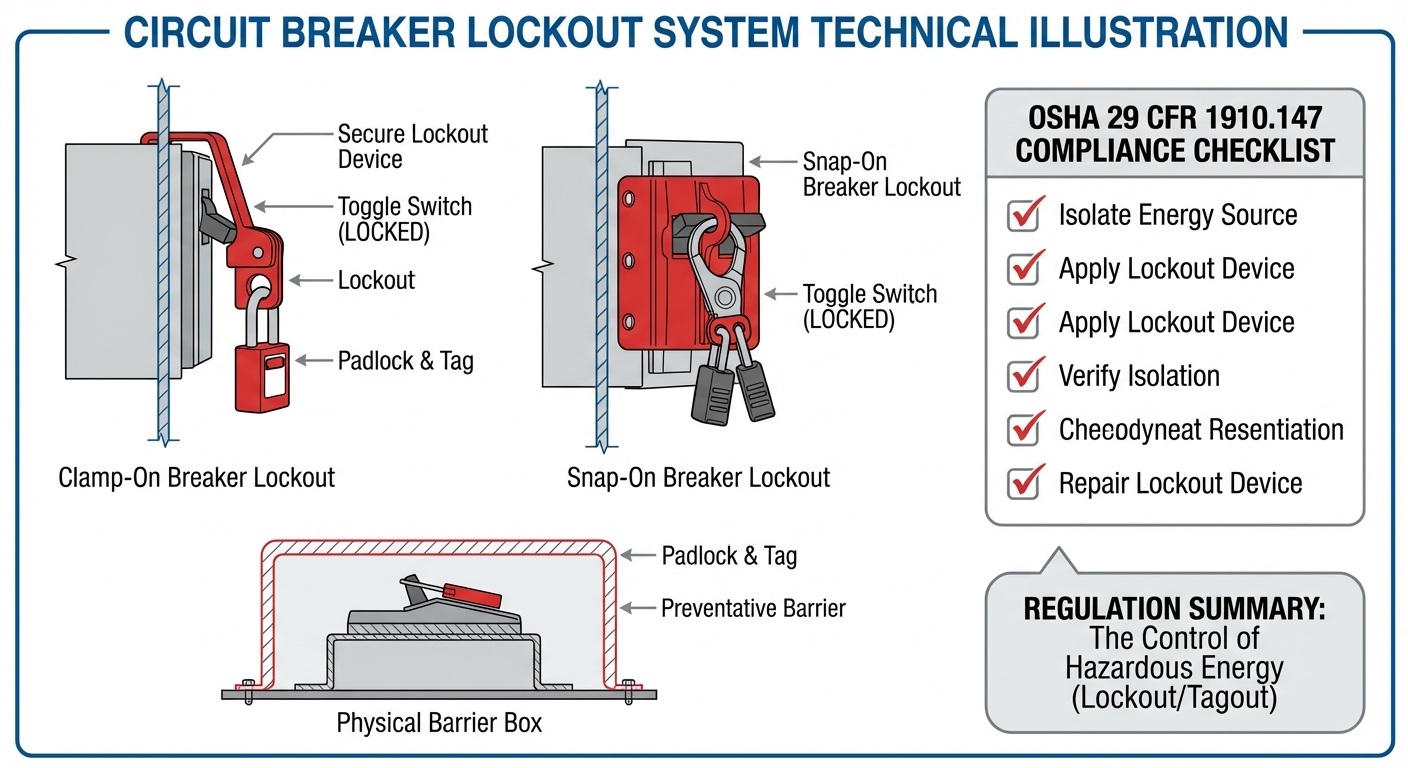
“Lockout devices… shall be substantial enough to prevent removal without the use of excessive force or unusual techniques, such as with the use of bolt cutters or other metal cutting tools.”
— 29 CFR 1910.147(c)(5)(ii)(C)
Shop Floor Translation: Your lockout device must physically prevent the breaker from being switched. If it wobbles, rocks, or can be defeated without tools, it’s not compliant. A loose toggle that someone can flip past isn’t lockout—it’s theater.
The regulation also requires devices be “capable of withstanding the environment to which they are exposed for the maximum period of time that exposure is expected.” Inside an electrical panel means heat cycling, potential moisture, and years of service. That $8 plastic toggle from the hardware store? It gets brittle. It cracks. And then it doesn’t lock out anything.
A circuit breaker lockout device is a mechanical attachment that physically prevents a circuit breaker toggle from being moved to the ON position.
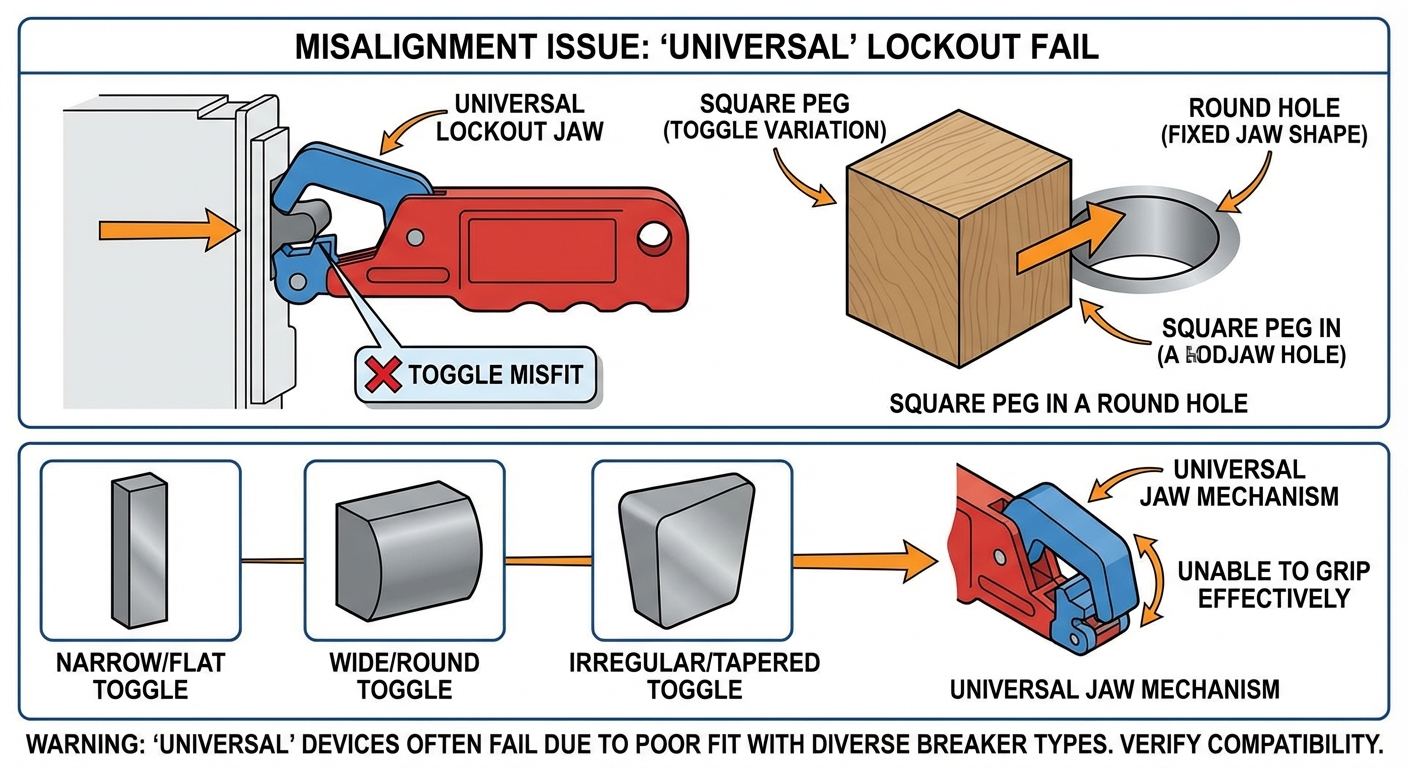
The problem with “universal” toggle lockouts: circuit breakers aren’t universal.
Breaker toggles vary by:
That universal toggle clamp uses an adjustable jaw mechanism. Tighten it down on a breaker it wasn’t designed for, and you get:
I’ve seen “locked out” breakers get bumped back to ON during panel work. The toggle lockout was technically installed. It just didn’t actually prevent operation.
| COMPLIANT | NON-COMPLIANT |
|---|---|
| Device seats flush against toggle with zero play | Toggle rocks or wobbles within device |
| Shackle hole aligns for padlock insertion | Shackle hole misaligned; lock applied at angle |
| Device rated for environment (heat, chemical) | Generic plastic showing UV degradation or cracks |
| Sized specifically for breaker manufacturer/model | “Universal” device that technically fits but allows movement |
AUDIT TRAP: An OSHA inspector doesn’t test your lockout device by looking at it. They test it by trying to move the breaker. If your “universal” toggle allows any toggle movement, you’ve got a (c)(5)(ii)(C) substantial violation—even if a lock is attached.
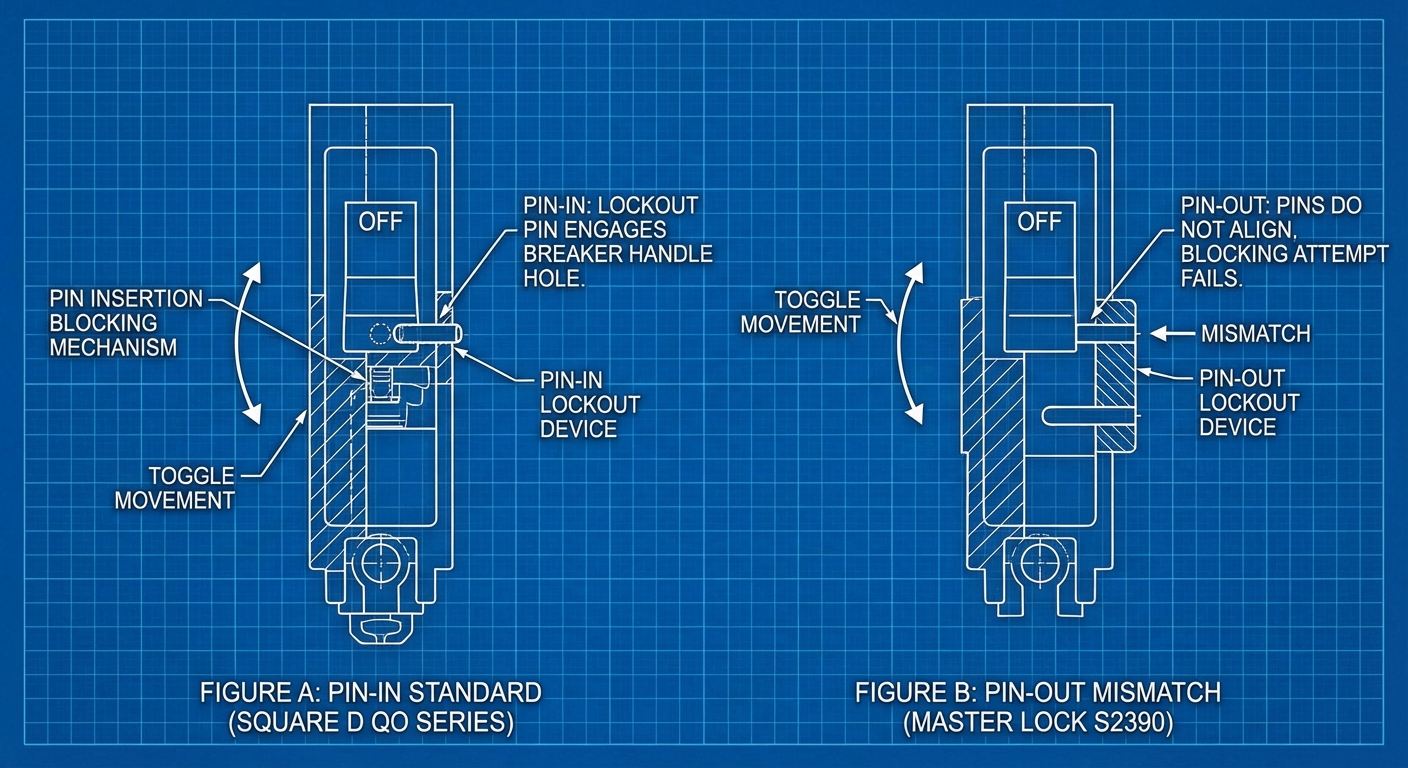
Most residential and light commercial breakers use pin-in standard design. There’s a small hole in the toggle face. The lockout device has a pin that inserts into this hole, mechanically blocking toggle movement.
Square D QO series and a few others use pin-out design. The pin protrudes from the toggle. Your lockout device needs a receiving hole instead of a pin.
Get this wrong, and the device won’t attach at all. Or worse—it attaches loosely and creates false confidence.
Pin-in breaker lockouts work with:
The Master Lock S2390 series handles most pin-in standard breakers. The pin diameter and toggle clamp width accommodate the 80% of breakers you’ll encounter in commercial/industrial panels.
Pin-out breaker lockouts work with:
You need a dedicated pin-out lockout like the Master Lock S2391 or Brady 65387. These have a receiving slot instead of a protruding pin.
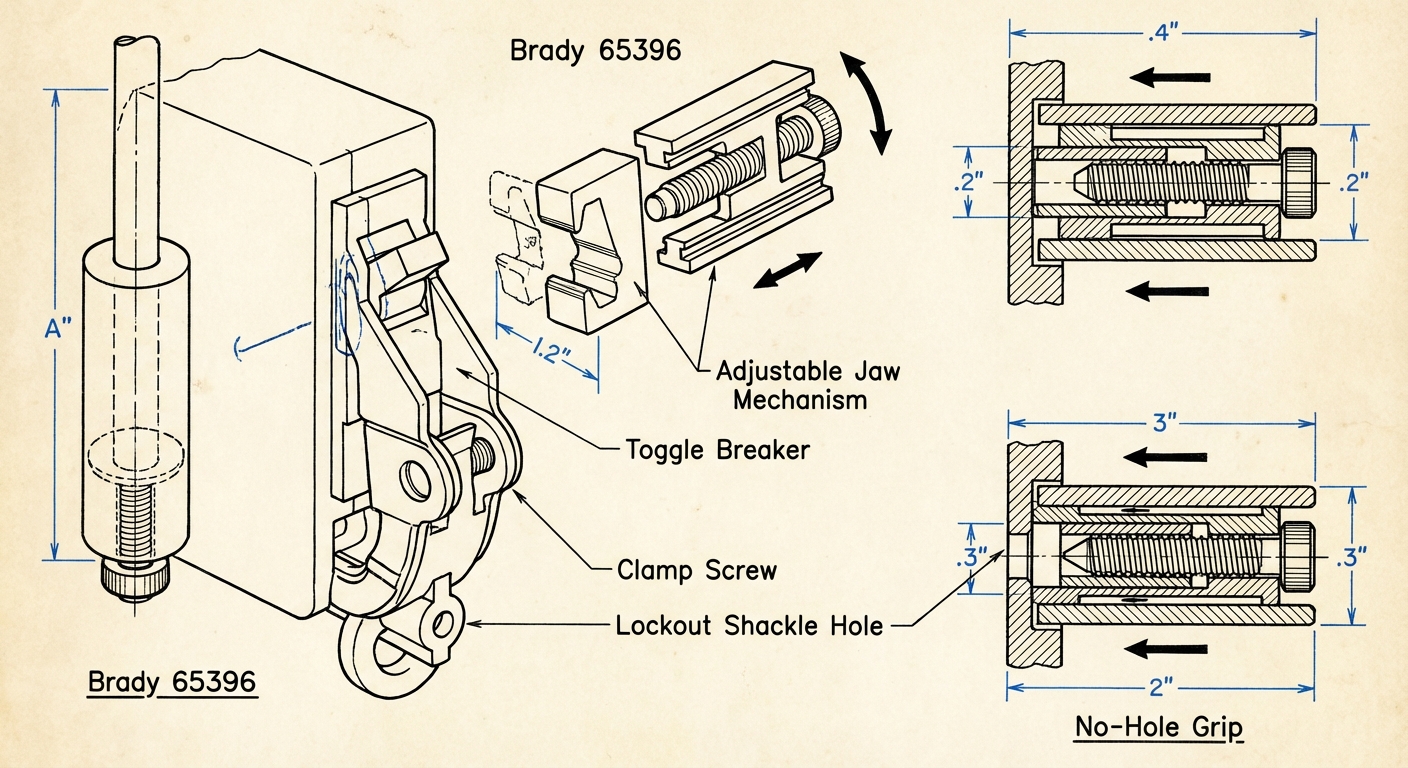
Here’s where fitment anxiety peaks: older breakers and some international models have no pin holes at all. The toggle is just a solid piece of plastic.
A clamp-on lockout device uses a mechanical jaw that grips the toggle body from the sides. The brady 65396 is the standard here—adjustable jaws that accommodate toggle widths from 0.4″ to 0.75″, with a thumbscrew tightening mechanism.
Clamp-on lockouts also work on:
The tradeoff: clamp-on devices require more installation time. You’re adjusting jaws and tightening screws instead of just snapping on a purpose-fit device. In high-volume lockout situations, that adds up.
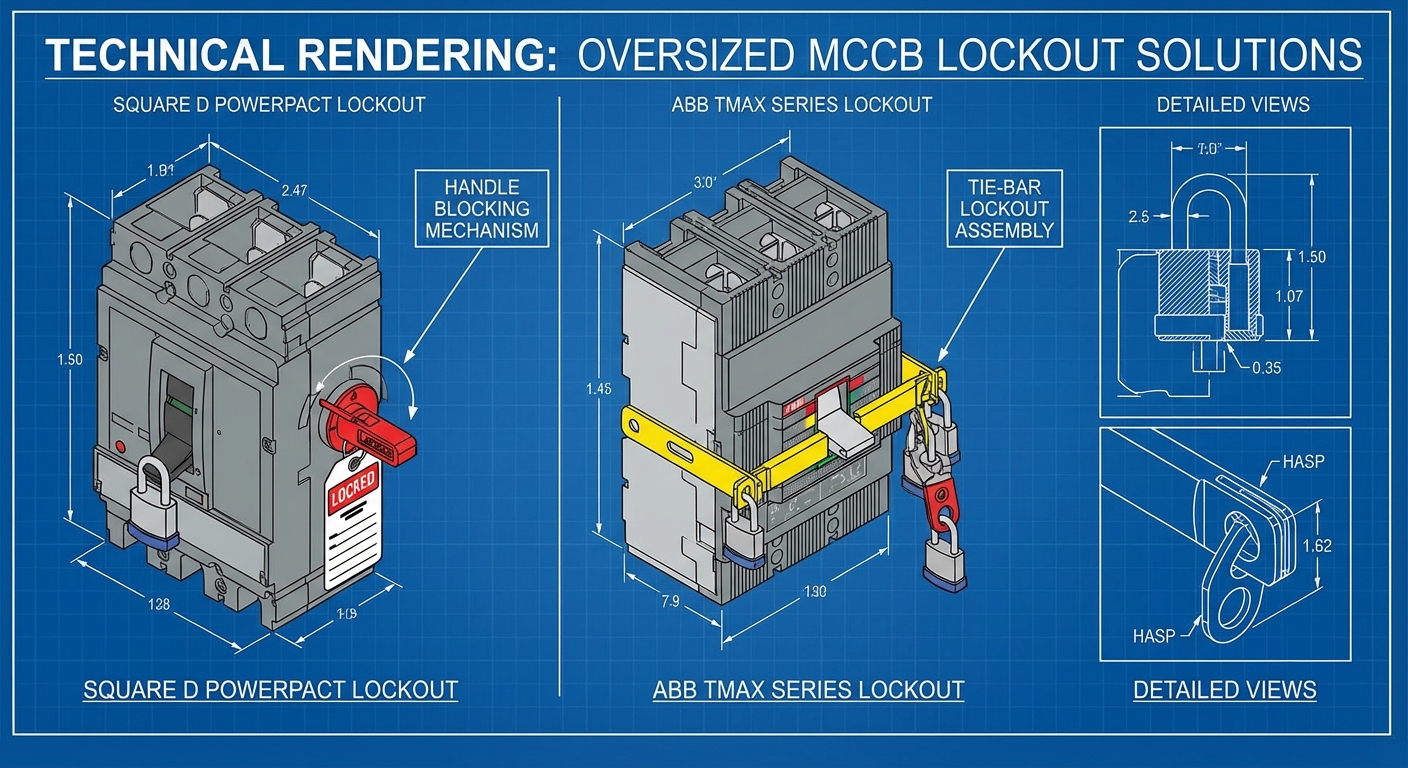
Molded case circuit breakers (MCCBs) in the 100A-2500A range don’t use the same toggle geometry as branch circuit breakers. These are the big units in main distribution panels—and standard toggle lockouts won’t touch them.
An MCCB lockout device is a mechanical attachment designed for the larger toggle throw and body dimensions of molded case circuit breakers rated 100A and above.
For MCCBs, you need:
The Brady 66321 handles Square D PowerPact breakers. The master lock S3822 covers ABB Tmax series. You’re matching lockout to specific breaker model, not just “big breakers.”
AUDIT TRAP: I see facilities lock out the upstream disconnect and skip the MCCB entirely. That’s not LOTO—that’s isolation without individual lockout. Every energy isolating device in the procedure needs its own lockout device. The MCCB counts.
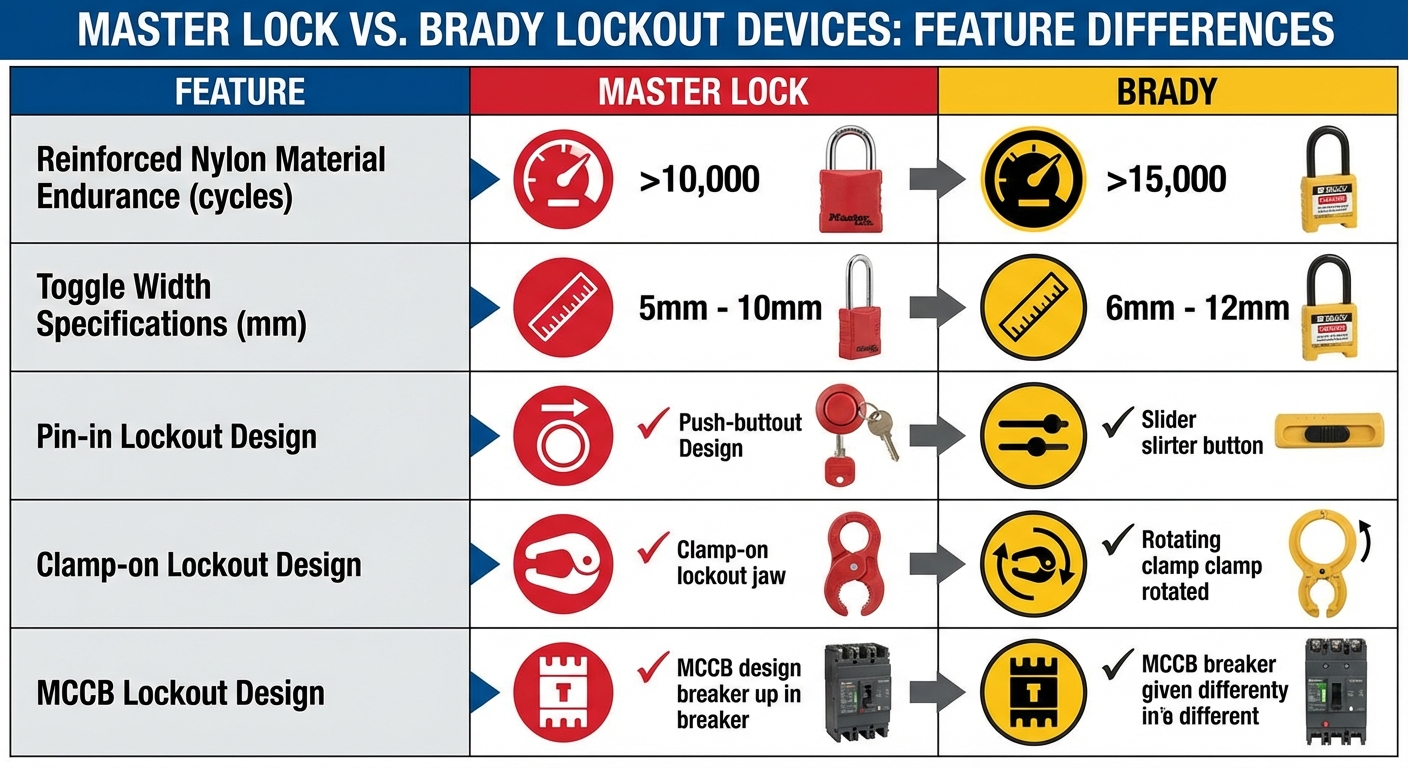
| Feature | Master Lock S2390 (Pin-In) | Brady 65396 (Clamp-On) | Master Lock S3822 (MCCB) |
|---|---|---|---|
| Breaker Type | Standard pin-in toggle | No-hole/universal toggle | ABB Tmax MCCB |
| Toggle Width | Up to 0.75″ | 0.4″ – 0.75″ adjustable | N/A (handle block) |
| Material | Reinforced nylon | Reinforced nylon | Steel/nylon |
| Operating Temp | -40°F to 212°F | -40°F to 212°F | -40°F to 212°F |
| Shackle Hole | 0.28″ (fits most LOTO padlocks) | 0.28″ | 0.25″ |
| Street Price | $8-12 | $15-20 | $25-35 |
| Best For | High-volume standard panels | Mixed/older breaker inventory | Main distribution panels |
For most facilities, you need all three categories in inventory. Standardizing on one brand simplifies ordering, but don’t let brand loyalty override fitment requirements.
Q: Can I use one universal toggle lockout for all my breakers?
A: No. “Universal” toggle lockouts fit a range of breaker sizes, but they don’t fit all manufacturers or configurations. Pin-in vs. pin-out alone requires different devices. Verify fitment before assuming any device works facility-wide.
Q: What if my lockout device fits but wobbles slightly?
A: A wobbling device may allow partial toggle movement, which violates the “substantial” requirement under 1910.147(c)(5)(ii)(C). Replace it with a properly-sized device. Loose fit isn’t compliant fit.
Q: Do I need to lock out every breaker in a procedure?
A: Every energy isolating device identified in your machine-specific energy control procedure requires its own lockout device. If the MCCB is an isolation point, it gets locked out—not just the upstream disconnect.